NEW SOLO EXHIBITION
Hiroko Ohno: Event Horizon
October 15 – November 15, 2026
Amos Eno Gallery, New York
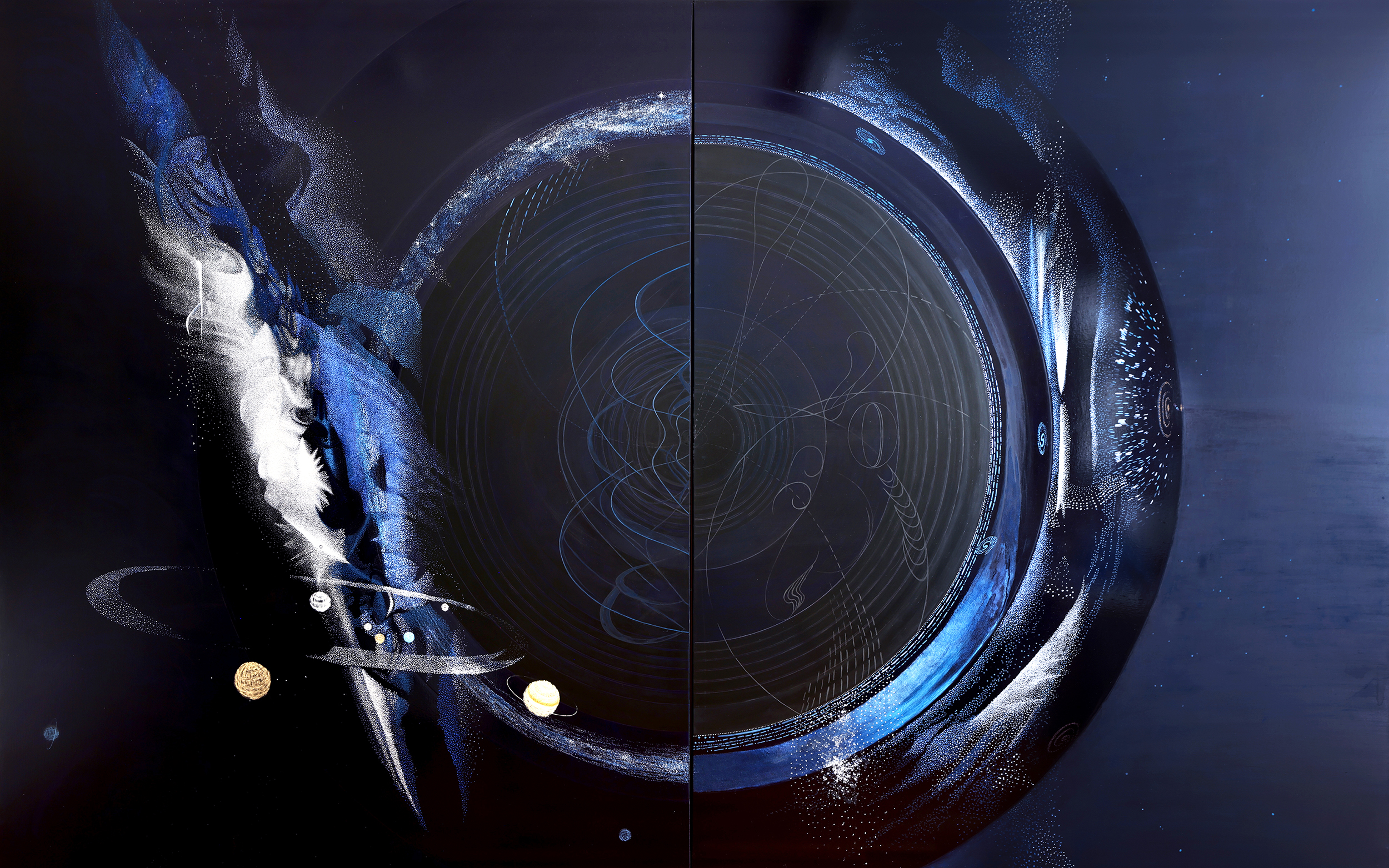
Galaxy: Event Horizon, 2018–2021 (diptych). Mineral pigments, seashells, mica, coral, salt, acrylic on linen. 96 × 152 inches.
Charlotta Kotik
Former Chair and Curator of Contemporary Art at the Brooklyn Museum
Space and Its Magnificence
The work of Japanese-born artist Hiroko Ohno, now a Brooklyn resident, is prophetic. It deals with interstellar spaces, our constantly evolving observation of the cosmos and its phenomena, and man's attempts to ultimately conquer it for his own use — which, tragically, can also spell misuse. At a time of the constantly accelerating race to subdue space for many different reasons, the work of Hiroko Ohno is taking a different approach — that of presenting the diversity, beauty, and complexity of the universe and our need to learn about its endless apparitions.
Ohno's gravitation towards the conceptual pondering and the physical depiction of the constantly changing skies and the magical spaces they create is longstanding. When looking at early works such as Dispatch from Seneca, 1985, we are encouraged to think about our relationship with our surrounding interior spaces, their everyday utilitarian furnishings, but also our relationship toward the Universe — suggested in this piece by large circular forms possibly alluding to the shape of the moon.
Connecting the everyday human experience and our overall perception of space was thus at the very beginning of Ohno's artistic endeavors. It is her own personal encounter with the objects' position in the interstellar sphere that is at the core of her aesthetics. An avid traveler, Ohno encountered a phenomenon that deeply affected her — she witnessed the simultaneous setting of the sun and rising of the moon, which gave her a new perception of the immensity of the universe and the position of the planet Earth within its structure. It is a world full of wonders and unexpected encounters that is at the core of Ohno's visual philosophy and aesthetic.
Materials used in the creation of the works are mostly drawn from nature. Mineral pigments used in the majority of Ohno's paintings were created over millions of years within the depths of our planet. They indicate various geological strata and the immensity of cosmic time. But there are also other more common substances in use, some alluding to the immediate present and to the artist's environment of the moment, such as shells, corals, mica, and other more common minerals.
The artist travels extensively, often to hard-to-reach places — all of them selected for one reason: to uncover additional mysteries and beauty of the universe.
It was the already mentioned experience in the Gobi Desert in Mongolia where the almost mystical appearance of the rising moon and setting sun on the horizon became a revelation. The immensity of the universe and the endless variations of the visual phenomena it creates had a lasting impact on the artist. Ohno devoted her career to depicting the elements connected with astrophysics and cosmology, frequently also with the geology of the particularly selected areas. She carefully chooses her travels to places that can enhance knowledge in either of the mentioned disciplines.
One such place is the Atacama Desert in Chile, home of the famed ALMA Observatory, which plays an important role in the Event Horizon Telescope project. The place is considered to be a prime space for astronomical studies — it is deemed to have the darkest night skies in the world. There she met a number of astronomers and further enhanced her theoretical knowledge of astronomy and astrophysics.
The Event Horizon Telescope project was a major source of inspiration for some of the most iconic pieces of her career, including the monumental two-canvas Galaxy: Event Horizon. Ohno completed its right-hand canvas at the end of 2018 and exhibited it independently in January 2019. She completed the second canvas in 2021, bringing the two together as a single work, which is presented in its complete form for the first time in this exhibition.
Having long wished to visit ALMA, she finally traveled there in 2023 after completing the two-canvas painting. The visit further deepened her exploration and inspired her subsequent works. Ohno captured images for Milky Way while painting outdoors under the canopy of the famed darkness, observing changes in the position of all the varied astronomical elements. Naturally, the direct observation of galactic events is transformed by the artist's imagination into an array of unexpected situations and intergalactic beauty. The series deals with space and color in a way unique in the story of contemporary painting.
The title of the exhibition, Event Horizon, is based on the Event Horizon Telescope project. The radio telescopes in this global network are synchronized to ultimately create one large telescope that can collect data from different parts of the observed skies. The long-term goal of the project is to reach a deeper knowledge and understanding of black holes, including their origins, behavior, and gravitational pull.
Beautiful as individual works of art, the pieces in this series lead far beyond the aesthetic experience — they lead us into an intellectual consideration of the cosmos, into thoughts that vastly expand the boundaries of our imagination of the universe. It is the masterly depiction of interstellar spaces and the captured movement of celestial bodies that makes us ponder Ohno's paintings for extended periods of time. Not at all illustrative, they still capture the immense realities of the cosmos that have inspired human curiosity and imagination since the very beginnings of time.
Ohno states herself: "I began researching black holes, gravitational waves, wormholes, spacetime and the large-scale structures of the universe. I was not interested in illustrating these scientific phenomena. Rather, I wanted to construct a pictorial space in which different scales, forces, distances and dimensions could coexist and through which invisible structures might become perceptible."
In all of that, Hiroko Ohno succeeded brilliantly.
Charlotta Kotik
Brooklyn/Prague
September 2026
New York, NY 10002
347-670-3310
Wednesdays through Sundays, 12–6 PM
Friday, October 16
6 – 8 p.m.
Amos Eno Gallery is pleased to present Event Horizon, a solo exhibition of new paintings and sculptural elements by Japanese artist Hiroko Ohno. The work on view explores the invisible structures that connect cosmic formation, geological time, and human experience.
Humanity has entered a new era of seeing the universe. Recent advances in astronomy — including the Event Horizon Telescope (EHT) project, which produced the first images of a black hole — have revealed phenomena once thought impossible to observe. Rather than illustrating these scientific discoveries, Hiroko Ohno's Event Horizon responds to the questions they provoke, presenting paintings and sculptural elements that explore the invisible structures connecting cosmic formation, geological time, and human experience. Through painting and subtle spatial interventions, the exhibition invites viewers into a space where visible forms continually suggest deeper layers of matter, energy, and time.
This exhibition builds on an inquiry that has shaped Ohno's practice for more than three decades. Her fascination with the universe began not through scientific research but through direct experience: witnessing the setting sun and rising moon simultaneously across the horizon in Mongolia's Gobi Desert profoundly altered her perception of Earth as a planet suspended in space. During her first visit to New York, she met Minimalist artist Tadaaki Kuwayama, whose rigorous pursuit of reduction and spatial clarity encouraged her to further refine her own visual language. Since then, Ohno has developed an ongoing dialogue with astronomy, geology, and cosmology — not to explain scientific knowledge, but to explore enduring questions of existence, time, gravity, and humanity's place within a vastly larger continuum.
At the center of the exhibition is Galaxy: Event Horizon, a monumental two-canvas painting measuring 96 by 152 inches. Inspired by the Event Horizon Telescope project and its attempt to produce the first image of a black hole, the work developed from Ohno's long-standing investigations of gravity, spacetime, astronomical distance, and the relationship between the visible and invisible. Within its semicircular structure, astronomical distances are translated into proportional intervals, while curved lines evoke gravitational waves and the distortion of spacetime. Rather than illustrating scientific phenomena, the painting constructs a pictorial space in which different scales, forces, distances, and dimensions coexist.
Material itself is central to that investigation. Ohno works with traditional Japanese mineral pigments formed over millions and billions of years within the Earth. Some materials, including platinum, predate the formation of our planet, allowing the works to embody — not merely depict — deep geological and cosmic time. The paintings themselves reveal multiple temporal layers, with dark blue surfaces often concealing luminous fields of red beneath them, suggesting that every visible surface contains unseen histories and processes extending beyond immediate perception.
Drawn by questions raised through the Event Horizon Telescope project, Ohno traveled to Chile's Atacama Desert, where she visited the ALMA Observatory and painted the Milky Way beneath one of the darkest night skies on Earth. These firsthand observations became integral to the development of Galaxy: Event Horizon and reflect her commitment to direct experience in an increasingly mediated world.
By bringing together materials that embody billions of years of planetary and cosmic history with works shaped by direct observation and contemporary scientific discovery, Event Horizon creates a space where art and science meet through wonder rather than explanation. At a moment when astronomy continues to expand the limits of human perception, Ohno's work invites viewers to look beyond the visible world and to imagine their place within the universe. Seen from a cosmic perspective, humanity is no more than a tiny speck of dust. In the Anthropocene, her work encourages us to reconsider the value of all forms of existence — not only human life, but also animals, plants, rocks, fire, and the materials that have shared Earth's history for billions of years.
Download Original Press Release (PDF)Download Press Release with Charlotta Kotik Essay (PDF)
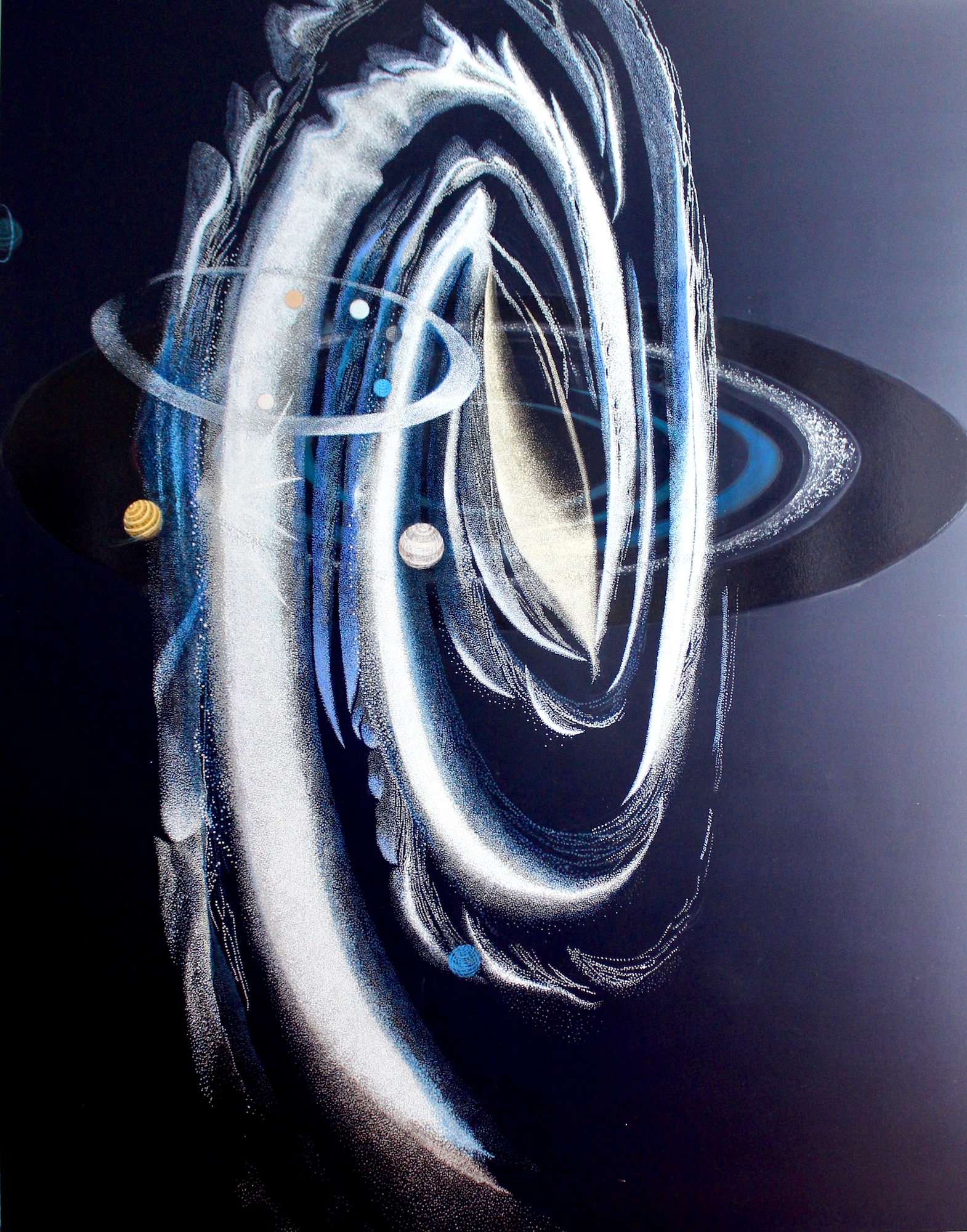
Milky Way, 2023
mineral pigment, lapis lazuli, azurite, seashells, coral, mica, acrylic, on linen, 96 × 76 in
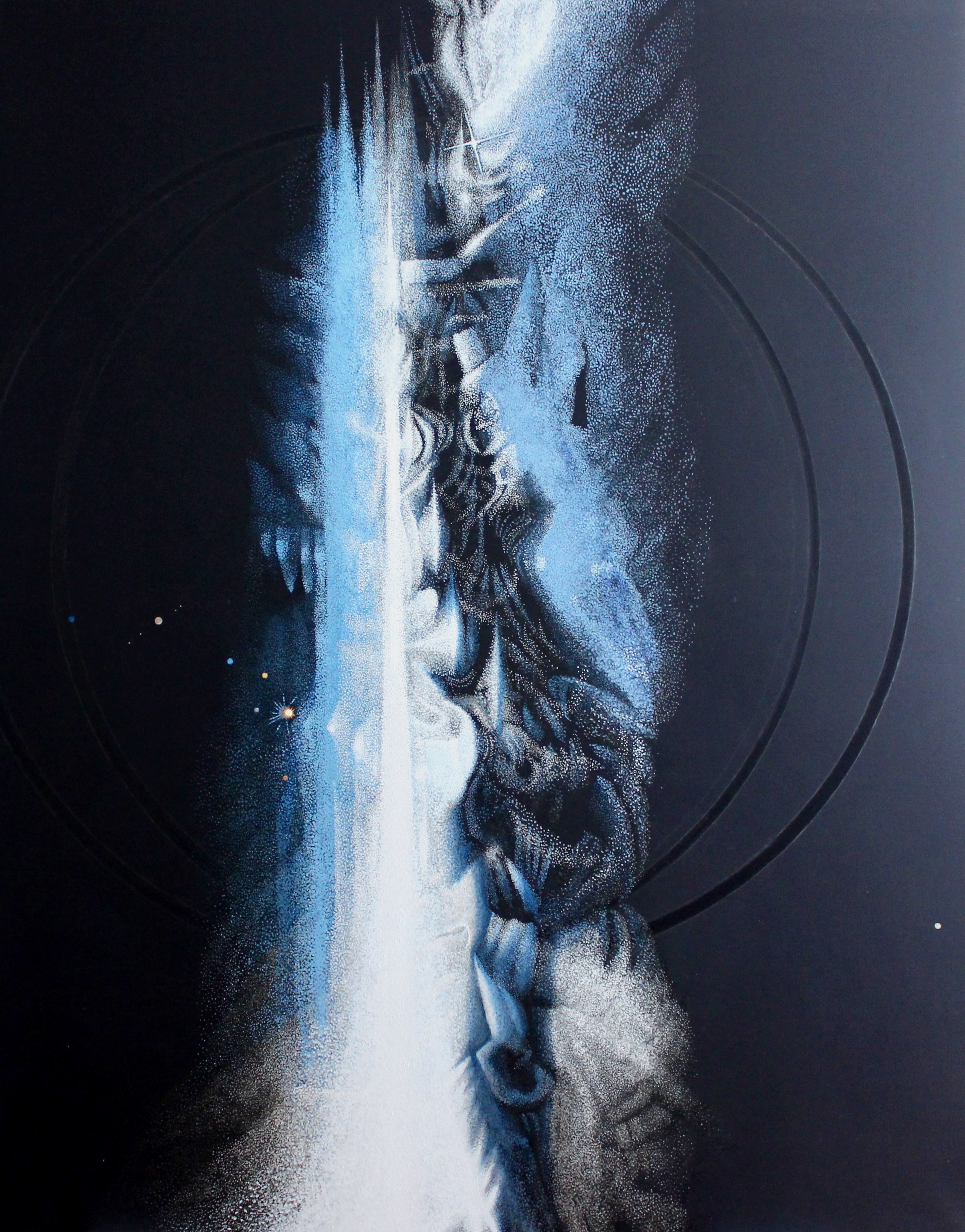
Milky Way, 2025
mineral pigment, lapis lazuli, azurite, seashells, coral, mica, acrylic, and salt on linen, 96 × 76 in

My first-panel discussion in New York.

Hiroko Ohno, Galaxy, 2021. Mixed Media on indigo ganpi paper mounted on wood panel, 35" x 25"
 March 31, 2023
All Featured Reviews


Galaxy I, 2023, mineral pigment, seashells, coral, mica, acrylic on linen, 20" x 16"

Drawing, Saturn/Jupiter, 2021, watercolor pencil on Fabriano Murillo Paper, 9" x 12"

Galaxy I, 2010, mineral pigment, platinum, bound by animal glue on natural paper mounted on wood panel, 35.75" x 25.75"


March 2 - April 1, 2023.

Galaxy-Event Horizon III, 2023, mineral pigment, seashells, mica, coral, Acrylic on linen, 40" x 30"


Galaxy - Event Horizon, 2018 / mineral pigment, lapis-lazuli, azurite, seashells, coral, mica, acrylic, salt on linen, 96" x 76"

Homma Museum of Art in Sakata city in northern Japan.
Artist talk January 12 at 2pm

Galaxy Around Us, 2017 / mineral pigments and acrylic on canvas board, wire, magnets / 33" H x 30" W x 19" D
Asia Week - San Francisco, CA

Galaxy, 2018 / mineral pigment on konshi paper mounted on wood panel / 36" x 26"


Untitled, 2016 / paint on steel
Curated by David Kiehl, Curator at the Whitney Museum.
Silvermine Art Center, CT

Borderless, 2016
Lite-Haus Galerie, Berlin

Tokyo Waterfall, 1993
Homma Museum of Arts, Japan

